
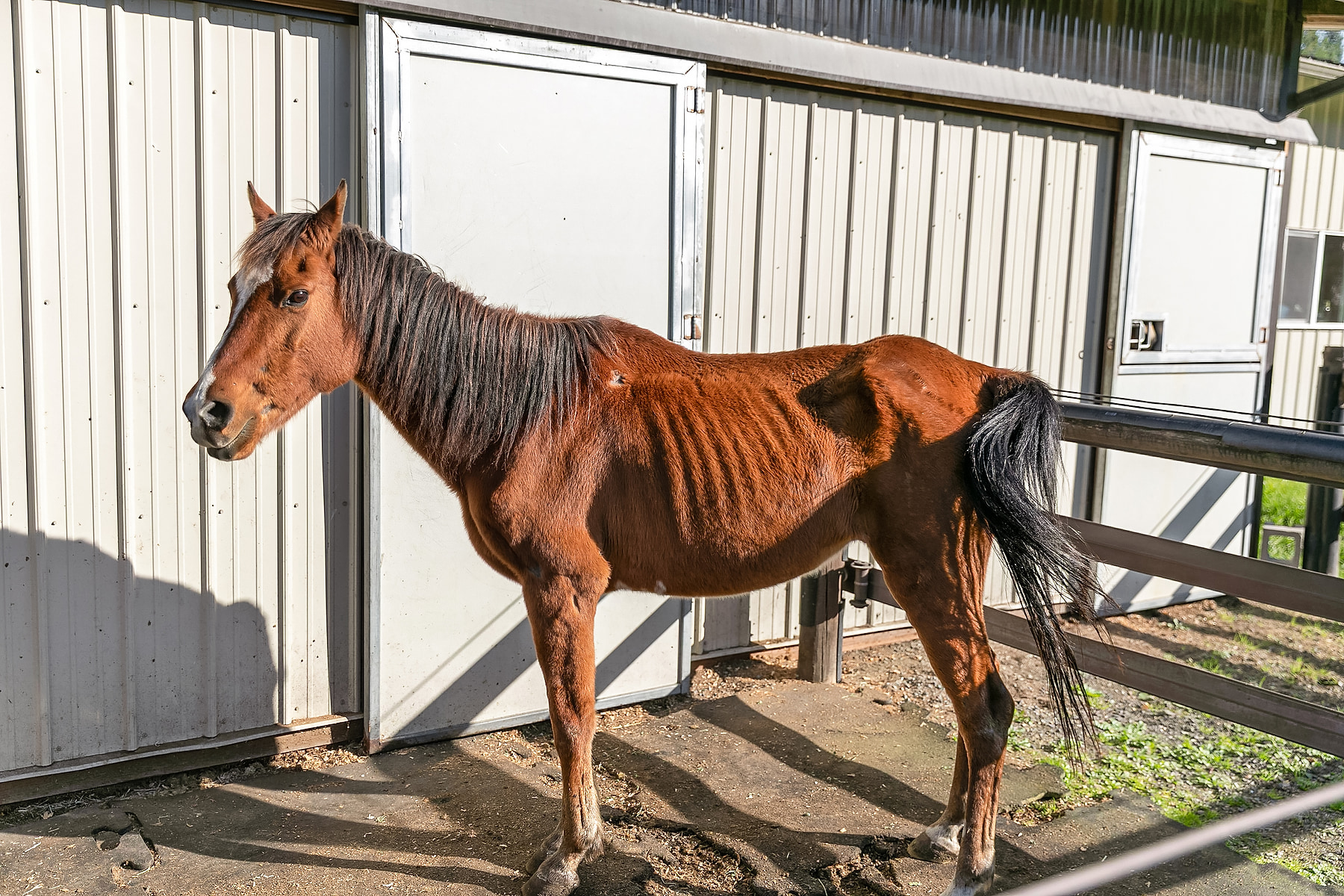
Beau stepped off the trailer at Safe Harbor Stables looking like a horsehair coat draped over a skeletal frame, and touching him gave that same impression — all the places where you’d hope to find a cushy spot for a scratch or a pat were concave, with no fat or muscle. Each of Beau’s ribs was clearly visible, as were the points of his hips and buttocks.
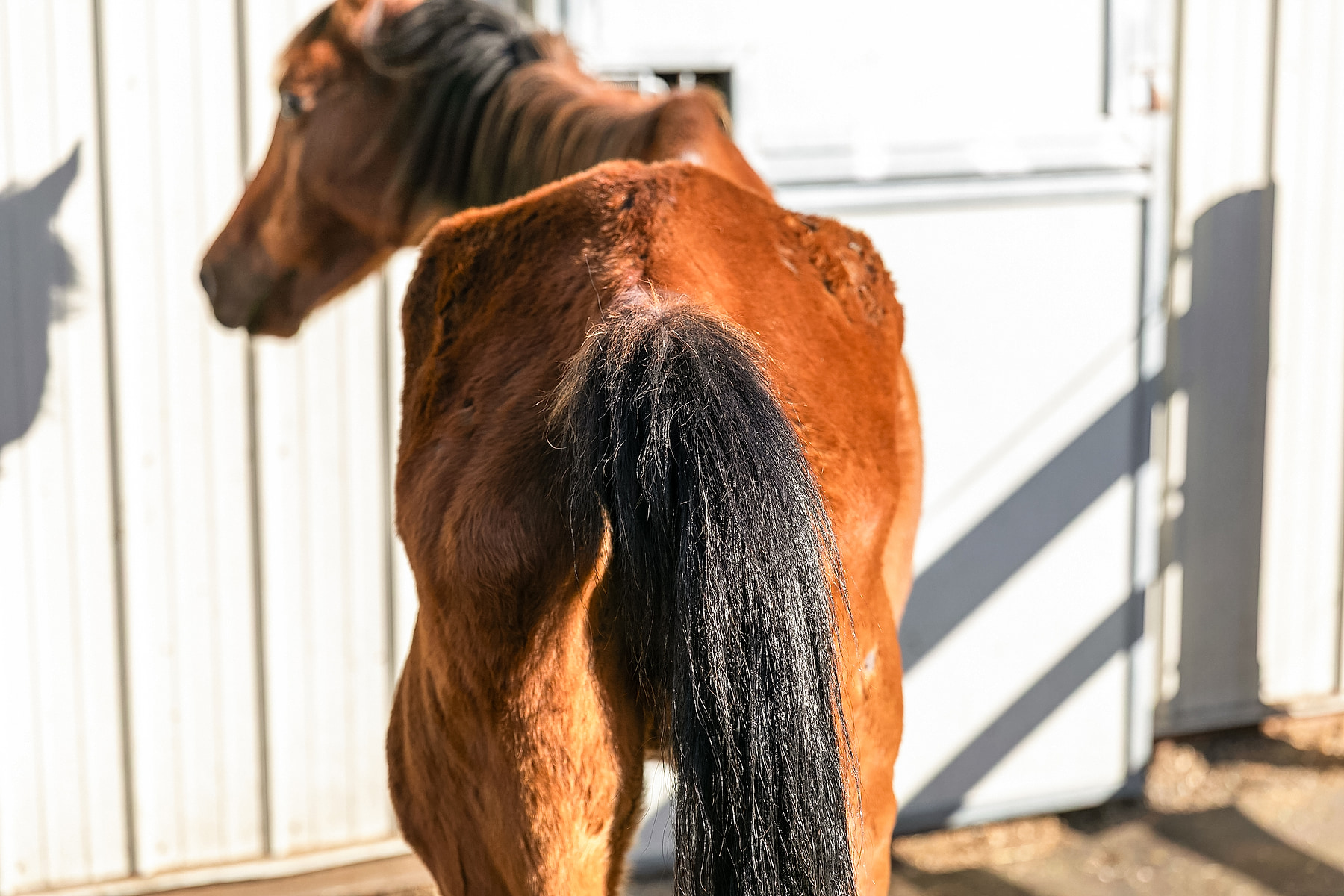
Viewed from behind, Beau’s extreme emaciated state is even more apparent.
Beau’s Equine Body Condition Score (BCS) was a 1, the lowest possible score on the Henneke system.
BCS scoring is done by a veterinarian, and the process includes a visual appraisal and manual palpation of the fat cover over the six points of the horse that are most responsive to changes in body fat levels: neck, withers, shoulder, ribs, loin, and tailhead. The Henneke system provides a standardized BCS regardless of the horse’s breed, age, body type, or sex. For this reason, the system is widely used, and US courts accept it as an objective way to score a horse’s body condition in animal cruelty cases.
A “perfect 10” isn’t the goal. BCS runs from 1 (Emaciated) to 9 (Extremely Fat). The ideal score is 5 (Moderate), and a range of 4 to 6 is acceptable.
Starvation this extreme has serious effects. Because Beau wasn’t being fed regularly, his body couldn’t replenish its fat and carbohydrate stores. Once those stores were used up, his body began breaking down protein from his muscles and possibly even his organs.
To give horses like Beau the best chance of survival, SAFE follows the refeeding protocol developed by expert researchers at the University of California, Davis.
Claudia Sonder, former director of UC Davis’ Center for Equine Health, reminds us that “no two starvation cases are ever the same.” Still, Beau’s first month of recovery shows how we put the protocol into practice here at SAFE.
The hazards of refeeding
When you look at a horse in Beau’s condition, you’ll likely want to give him all the food he has been denied. But a careful diet and slow refeeding are crucial to avoid overwhelming his system.
A sudden return to a high-carbohydrate diet causes a spike in insulin. That spike drives electrolytes — particularly phosphorus and magnesium, which are essential to the normal functioning of numerous organ systems — out of the bloodstream. A starved horse has few reserves left to replace these electrolytes, so repeated losses can lead to kidney, heart, and respiratory failure within days.
UC Davis research shows that alfalfa hay is ideal for refeeding a starved horse. It provides:
- High levels of protein for important nutrition
- High levels of phosphorus and magnesium to rapidly rebuild electrolyte reserves
- Low carbohydrate content to minimize insulin spikes
As a bonus, most horses love the taste! Beau certainly dove right in.
Round-the-clock nutrition
Days 1–3
For the first three days of a horse’s recovery, we feed one pound of high-quality alfalfa every four hours — day and night — for a total of six pounds per day. That’s not much, considering a normal horse may eat as much as 30 pounds of hay a day.
We always weigh our hay to make sure we’re feeding consistent amounts to all our horses, but that precision matters most during refeeding.
Many BCS 1 horses who come to SAFE also have teeth in poor condition, which makes proper chewing difficult. We help make digestion easier by picking through the hay to make sure we’re offering more leaves than stems.
Days 4–10
On day four, we slowly begin increasing the amount of alfalfa provided at each meal, starting by adding one pound per day, spread across all six feedings.
The UC Davis protocol allows the number of feedings to drop from six to four after the first three days. But because we have the staff capacity to support it, SAFE retains the full schedule of six feedings per day for the entire crucial 10-day period of the horse’s early recovery. After day four, we do spread the nighttime feedings slightly farther apart to help our care team get a bit more shut-eye.
By day 10, the horse is eating about 16 pounds of alfalfa per day.
After day 10
If things are going well after day 10, we check back in with our vets for the OK to move the horse to free-choice hay. A very happy day for us all!
Free choice really means free choice: We hang a bale net in the horse’s stall and keep it full at all times. We continue to weigh the hay and track when the net is refilled so we know how much the horse is eating, but the horse has complete choice over how much hay they eat.
With veterinarian approval, we begin offering small amounts of grain and targeted supplements.
While weight gain is noticeable after the first month, but it can take up to five months for a BCS 1 horse to reach a normal body weight.
Looking beyond the surface
When we see a BCS 1 horse like Beau, we also watch for any other medical conditions that may have been worsened the effects of starvation.
All new SAFE horses see a vet at intake, and it’s a priority for horses with a low BCS. Following Beau’s arrival at Safe Harbor Stables, we pulled blood for a CBC panel. The exam and bloodwork often show abnormal markers that our vets expect to resolve with proper nutrition. Surprisingly, in Beau’s case, all the bloodwork markers came back within the normal range. It’s a good sign. Less good: our vet observed a moderate systolic murmur, which may indicate some decreased heart function. We’ll continue to monitor.
We also ran a fecal test to check Beau’s parasite burden. We’ll consult with our vets and wait until he has regained more weight before deworming.
Are you seeing a theme here? SAFE has considerable experience helping horses recover from extreme starvation. We’re glad to have that expertise, even though we wish it were never necessary. Even so, we always work closely with our team of veterinarians, and we’ll keep checking in with them to support Beau through his recovery.
We kept Beau’s stall deeply bedded with shavings so he’d be comfortable if and when he decided to lie down and sleep. We also watched him closely to make sure he wasn’t eating any shavings. Hunger will sometimes drive a starved horse to eat things they wouldn’t ordinarily eat.
We provided fresh water at all times. For the first two weeks, we kept careful records of Beau’s water consumption, manure output, affect, and general demeanor. Like most horses with such a low BCS, he wasn’t exactly looking to frolic. Beau was a bit of an anxious boy in the first week, though, and he tried to pace the fence line if left out too long. We limited turnout to help him conserve calories.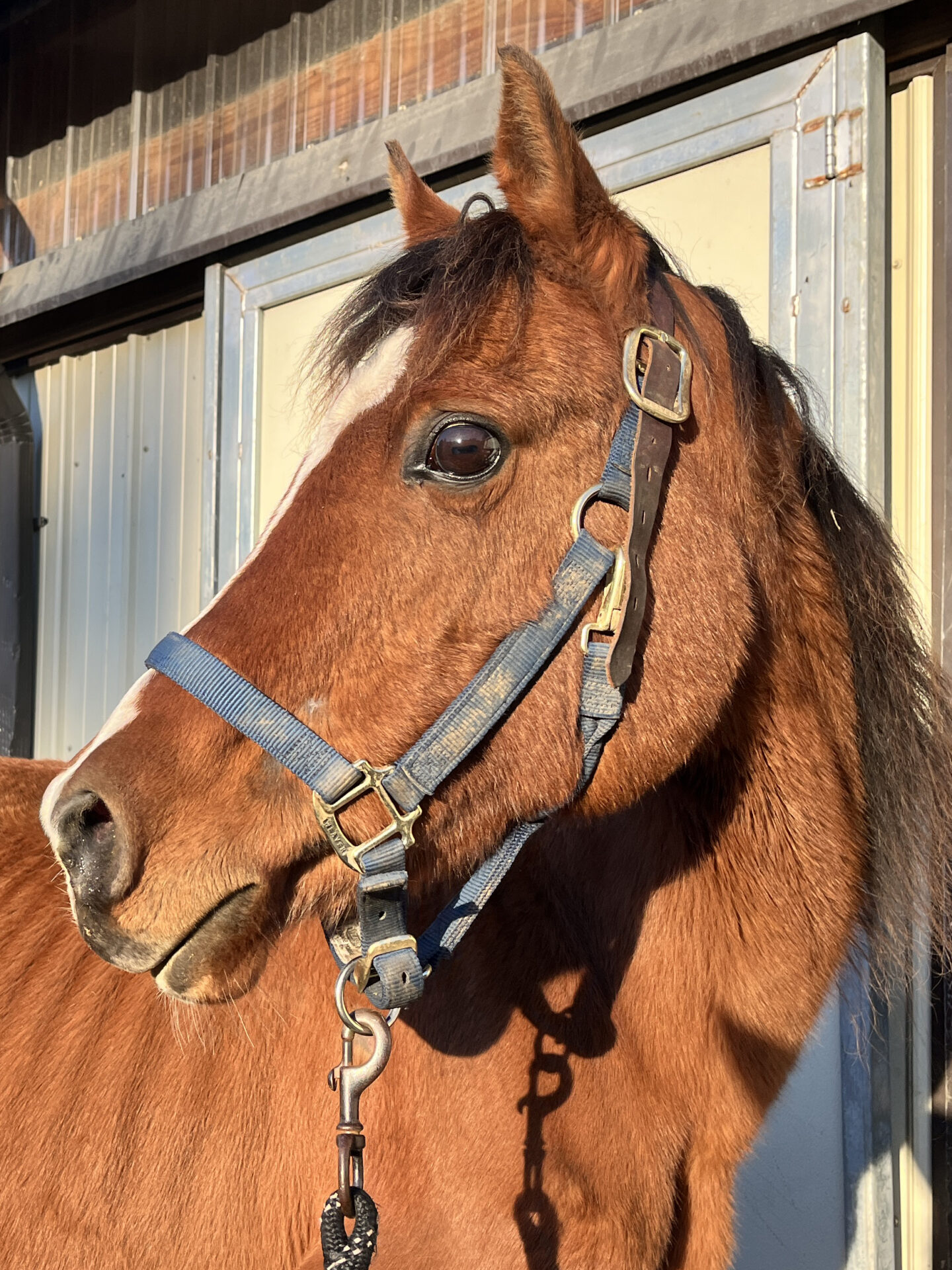
If a horse allows it, we weigh them at intake so we can track their progress. How do you weigh a horse? Not on any ordinary scale, that’s for sure. Livestock scales do exist, but SAFE doesn’t have one. (We dream of acquiring one someday.) Instead, we calculate a horse’s weight from their measurements. The typical method uses the girth measurement alone, but adding length tends to give a more accurate result for a BCS 1 horse. Beau is a gentle guy, so he let us take girth and length measurements with a weight tape without any fuss.
At intake, we calculated Beau’s weight to be 630 pounds. Four weeks later, Beau weighed in at 670 pounds. That’s 40 pounds gained in the first month! Beau is off to a great start, but he still has a long road to travel.
In our next post, we’ll look at two of Beau’s companions, Juniper and Emi-san, who arrived with a BCS of 2 and 3, respectively. Their stories will give you a peek at what Beau’s next stages of recovery might look like.
Supporting a horse as severely emaciated as Beau takes considerable resources. It’s not a task for the faint of heart (or those who love to sleep in). Thanks to the generosity of past SAFE donors, we can say yes without hesitation when we’re called on to take in horses like Beau and his companions. We know we have what it takes to give these horses the best chance at recovery.
You can help. Each November, our Fall into Winter Hay Drive aims to raise all the funds we need to purchase hay and grain in the coming year. For 2027, that’s $70,000 — and our fundraiser is behind schedule. Can you make a donation today to help make sure SAFE can say yes to horses like Beau in 2027 and beyond?
